Nothing can be more miserable or aggravating than being unable to breathe adequately when suffering from a cold or other congestion. Since the Northern Hemisphere is now in the throes of the winter season, the likelihood of this happening is much greater. According to a power point presentation from the Idaho State University College of Pharmacy, it is estimated that 100 million colds occur in the U.S. annually, resulting in 250 million days of restricted activity, 30 million days of lost work, 22 million physician visits, with a direct cost of $15 billion yearly. That some relief can be had through use of an inhalant is certainly welcomed news.
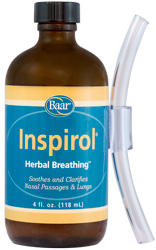 A popular remedy, Inspirol®, was mentioned in over 300 readings and recognized for its wide use for all sorts of respiratory problems: asthma, bronchitis, catarrh, colds, congestion, coughs, emphysema, hay fever, pleurisy, pneumonia, post-nasal drip, sinusitis, sore throat, and tuberculosis. While the formula varied slightly in different readings, it usually contained pure grain alcohol to which was added a number of oils (eucalyptus, pine needles, rectified oil of turpentine) plus compound tincture of benzoin, tolu balsam, and rectified creosote.
Luckily one reading itemized for us the beneficial effects of these ingredients:
“…the activities of the eucalyptus and the activity from the Tolu are to clarify or purify the lung tissue itself. The activity of the Turpentine is to act upon kidneys and liver for the assisting in tuning or toning the activity with organs for better eliminations through the system, while the other ingredients as they act upon the mucous membranes give better actions through the lymph circulation in the body-forces.” (1641-2)
Instructions for Its Use
Several readings give further directions on its use. The solution fills only a portion of the bottle; this is so that the fumes, after the bottle has been shaken, can be inhaled through a breathing tube placed in a hole in the lid. It is most effective when used regularly several times a day, such as in the morning after arising and in the evening before retiring, “or when there is a tickling or coughing, or the inclination for sneezing…when these occur any time during the day…” (2186-1)
With each use the container is shaken so that the fumes are released into the bottle. Then follow these directions from one reading: “Inhale into one nostril, holding the other, then into the other side; also into the throat—letting the fumes go into the lungs—not swallowing the inhalant, but inhaling the fumes, see? Hold either side of the nostril as it is inhaled in the other nostril.” (2186-1) One reading said to inhale into the nostrils twice and the throat once (1641-2).
Any time that fumes are inhaled the lungs are stimulated, the fumes functioning as an expectorant (assisting the lungs to slough off excess mucus) and as an antiseptic.
Indications from the Readings
In addition to some of the effects already mentioned, the inhalant assists in “the clarifying of the muco-membranes of head and throat…reducing the tendency for the glands to over-stimulate the muco-membranes and thus relieving the irritations.” (335-1) As “an antiseptic and a healer, [it] will prevent the sneezing, as well as the tendency for the lymph to drip from nostril and nasal passages.” (2801-6) It also helps with “purifying those areas through which sensory influences are at times clogged” (1641-2), and acts “not only as an antiseptic for the blood supply…but will also…act as an antiseptic through the intestinal system.” (318-5) For a person with bronchitis the “inhalant [would] cleanse throat and bronchi of those disturbances that contribute to the upsetting of the liver and the digestive forces…” (2975-1) To summarize: “…the properties in the inhalant are also purifying to the body, to cleanse or to correct causes.” (3094-1)
Several success stories are also reported in the readings. An A.R.E. member in Rancho Cordova, California, described her condition in a 1973 letter:
“In 1950 I started having bad headaches. The Reese-Stealy Clinic ran tests and found I was allergic to house dust and dry-grass pollen giving me chronic sinusitis.” She took a series of shots and pills for the next twenty-three years. After joining the A.R.E., she learned about the inhalant, ordered it, and began using it mornings and evenings “very faithfully. No more headaches, eyes swelling, sneezing, or choking. So I never went back for any more shots or pills from my doctor.”
Another woman’s husband had a terrible cold and couldn’t get an appointment with two separate doctors because they were too busy. His wife’s boss, who knew about Edgar Cayce, happened to have a bottle of the inhalant in his desk drawer and offered it to her. She took it home, her husband “tried it a couple of times that night before he went to bed. The next day he was fine, no coughing or sneezing. I couldn’t believe it, but there he was, no cold. He said he felt fine. I told him we saved money by not going to the doctor.” A construction worker, he didn’t miss even one day of work.
The inhalant has no harmful side effects, can be used as often as desired, and is sold today (with breathing tube included) by Baar.com the Official Worldwide Supplier of Cayce Health Care as Inspirol® Herbal Breathing™.
Call to place an order: 1-800-269-2502 USA
Call Customer Support: 610-873-4591
[Mon -Fri: 9 a.m. – 4:30 p.m. EST]


Elaine Hruska is a therapist at the A.R.E. Houston Spa and former teacher at the Cayce/Reilly* School of Massotherapy. This article is reprinted with permission by Venture Inward Newsletter, Virginia Beach, VA.
www.baar.com Baar Products is the Official Edgar Cayce Company
Having searched and finding this as the closest lung issues, there is no mention of C.O.P.D. Could someone please relate the findings regarding Edger Cayce’s cures to a cure for C.O.P.D.? I and many others would be most grateful to learn if there is help within these treatments and cures.
Hi Brad,
For a large number of respiratory conditions, including asthma, colds, coughs, hay fever, lung congestion, other respiratory ailments (bronchiectasis, bronchitis, chronic ob¬structive pulmonary disease, emphysema, fibrosis, nasal drip, pneumonia, sarcoidosis, smoker’s lung), pleurisy, shortness of breath, tuberculosis or TB tendencies, Edgar Cayce recommended a remedy involving breathing brandy vapors from a charred oak keg. More information can be found in the following articles:
https://cayce.com/health-solutions/edgar-cayce-charred-oak-keg-quick-easy-remedies/
https://cayce.com/health-solutions/edgar-cayce-charred-oak-keg-antiseptic-throat-lungs/
Following up from my previous comment and your reply. With all the benefits of Inspirol, are you telling me that Inspirol would not reduce the effects of C.O.P.D. which mimic or are the same as conditions Inspirol is effective against?
I read all the information on breathing brandy vapors from a charred oak keg. While it would be possible for me to follow that, it would present some difficulties. Why would the Inspirol not do what the brandy fumes do?
Thank-you, in advance, for sharing more of your knowledge and wisdom..
“Following up from my previous comment and your reply. With all the benefits of Inspirol, are you telling me that Inspirol would not reduce the effects of C.O.P.D. which mimic or are the same as conditions Inspirol is effective against?”
No, we were providing you with an additional option for your research.
“I read all the information on breathing brandy vapors from a charred oak keg. While it would be possible for me to follow that, it would present some difficulties. Why would the Inspirol not do what the brandy fumes do?”
Depending on the situation, it may do the same or more. Everyone’s body is different, there are also different causes for COPD. Many people check with their doctors first before experimenting with these items.
What about the use of Inspirol and the charred oak keg by a recovered alcoholic for emphysema and COPD? Would it cause a relapse in alcoholism?
Thank you for your question. We suggest they check with their Health Care Practitioner on both issues, the emphysema/COPD and the alcoholism. They would be the only one knowledgeable enough of the patient’s history to lend that sort of guidance.
I had dialog with this site about Inspirol before. I obviously thought about the product for a very long time, reading both the pages about it many times. I finally decided to order a bottle and it arrived today. I re-read all the instructions and followed them to the letter. One thing we were not warned about is the very strong irritating vapor that is being inhaled. I can tolerate it in my nose and mouth, but when it hits my lower trachea and lungs they spasm in reaction to the strong vapor, and it is hard to finish the inhale. There was no warning about this possibility in anything I read. Is this normal?
I will keep trying to use the Inspirol and maybe my body will adjust.
What is your reaction and what do you have to say about this?
Hi Brad,
Your experience with Inspirol is very reminiscent of my first time using it. It can be very potent stuff, especially when you’ve got a fresh bottle of it! The trick is to only use what you’re comfortable with at the time. You’ll get used to it pretty quickly and soon you’ll be taking deeper and deeper breaths. Here’s a handy video that may answer other questions you have with the Inspirol: https://www.baar.com/inspirol-herbal-breathing-aromatherapy#instructions
Thank-you for your reply. I decided to try something. I placed the tube to allow more room air to enter the tube as I inhale, thus diluting the good fumes somewhat. I was able to inhale deeply through each nostril and quite a bit better through my mouth. I will keep this up and develop my tolerance to the strength of the fumes and eventually reach the full strength of vapor being inhaled. Do you agree with my method?
I had several dialogues with this site from 8/2023 through 12/2024. I would read and reread this site and do some research on Inspirol on other sources I might find. I decided to buy my first bottle 12/2024 and have been using it ever since. I have no nasal issues except irritation from the canula I must wear for supplemental OX, so I only inhale by mouth. I found I must dilute the fumes some by opening my lips a bit, because the strength of the fumes makes my lungs spasm and cause me to choke. With this method I take 4 to 6 partially air diluted puffs per use 3 or more times per day. My lungs do feel better.
13 days ago, despite the Inspirol, I had to be transported to a hospital because I woke up with a (now rare) COPD flair-up. I chose Good Samaritan Hospital in Lebanon, PA, because they are partnered with Wellspan Pulmonary and Sleep. Wellspan Pulmonary and Sleep is reputed to be the source for the best doctors to treat COPD. At Good Sam I was put on Ox. Not one doctor discussed anything with me or asked me questions. They did take a chest X-ray but never shared anything they found in it. I was ignored until a nurse jammed a cigar-like device in my mouth and set it on fire. I assume that was a nebulizer. The smoke and fumes did nothing but irritate my face, nose and mouth. The nurse told me to inhale the fumes which were choke worthy at best. Otherwise, I was just lying in bed and would have gone crazy had there not been a TV in the room. I could not even get a nurse to show up when I hit the call button several times through the afternoon. (They would not allow me to go to the bathroom alone to pee.)
Finally, a young man showed up and stated they wanted me to stay for a few more days. With being basically ignored all day and feeling worse from the “treatment” and being ignored even more, I firmly declined and instructed him to send me home. Eventually an ambulance arrived to return me home. I have a dear friend who is a CNA who checks on me in person and by phone.
Once at home, I dosed on Inspirol and felt some immediate relief. I dosed 2 or 3 more times before going to bed for the night. Each dose added to my feeling of wellness. Also, clarity came to me in my 75-year-old brain, so I will share my thought. “How would you like to be treated in a hospital by a combination of the 3 STOOGES and THE LITTLE RASCALS ??”
Thank-you for Inspirol. And I plan on looking further into the charred oak barrel treatment for me.
Hi Brad,
Thank you for sharing your experiences. Others will find this very helpful.
Do you accept UHC cards as payment? Inspirol helps me breathe better, and seems to strengthen my lungs. Also, do you offer smaller bottles? I am still using the original bottle obtained through Heritage Products.
Hello,
Baar Products does not accept UHC cards as payment. Inspirol Herbal Breathing is only sold in one size.